Lightweight versus durability
Lower mass may suit a performance assortment, while a fleet may prioritize service life and replaceability. Ask suppliers to state construction rather than promising an outcome.
Channel and terrain language becomes useful only when it is translated into interfaces, material decisions, quantities, packing and evidence requests.
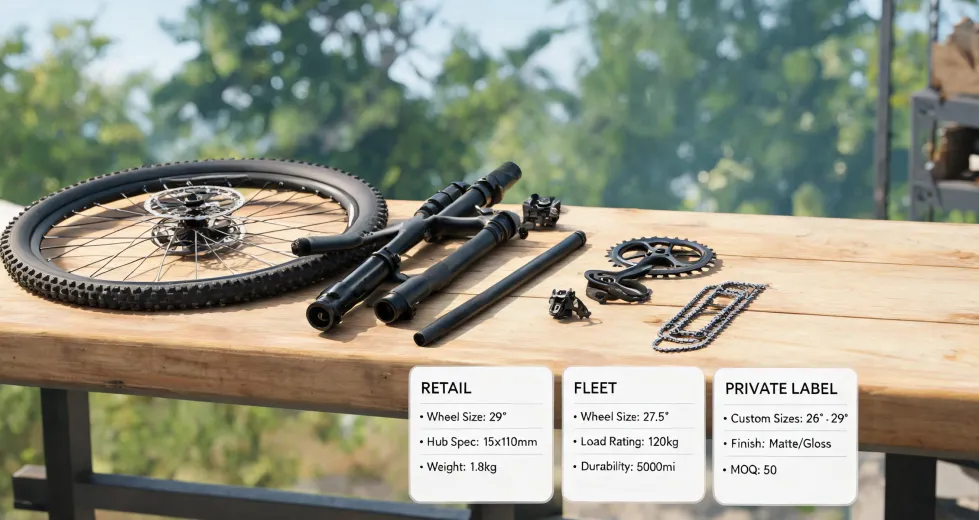 Describe the Buyer Program
| Buyer scenario | Specification anchor | Evidence question | Delivery question |
|---|---|---|---|
| Outdoor retail assortment | Interface range, finish references, package presentation | Which exact SKU and material response matches each variant? | What is the carton mix by SKU and destination? |
| Private-label MTB line | Artwork, color standard, sample approval and tooling | Which revision controls the quoted item and proof? | Which charges and production assumptions are excluded? |
| Rental or trail fleet | Service environment, wear item identification, replacement fit | How is compatibility supported for the named equipment context? | Are spares packed separately and clearly identified? |
| Institutional maintenance | Part list, quantity cadence, receiving labels | Which manufacturer and model appear on supporting documents? | What freight, handling and receiving scope is quoted? |
Lower mass may suit a performance assortment, while a fleet may prioritize service life and replaceability. Ask suppliers to state construction rather than promising an outcome.
A lower unit figure is not comparable when tooling, sample, packaging, freight or variant minimums differ. Normalize all stated inclusions first.
A product-family claim cannot confirm axle, bearing, thread or connector fit. Record measurable interface evidence for the proposed item.
A certificate or report from another model is a question prompt, not proof for the quoted component or intended US use.
Include terrain or equipment context, interface, construction, quantities, pack, destination and acceptance questions.